





Read “The Global State of Commerce 2026” report
Agentic commerce is one of those things: One day it’s on the periphery of your awareness and then, overnight, it’s everywhere all at once.
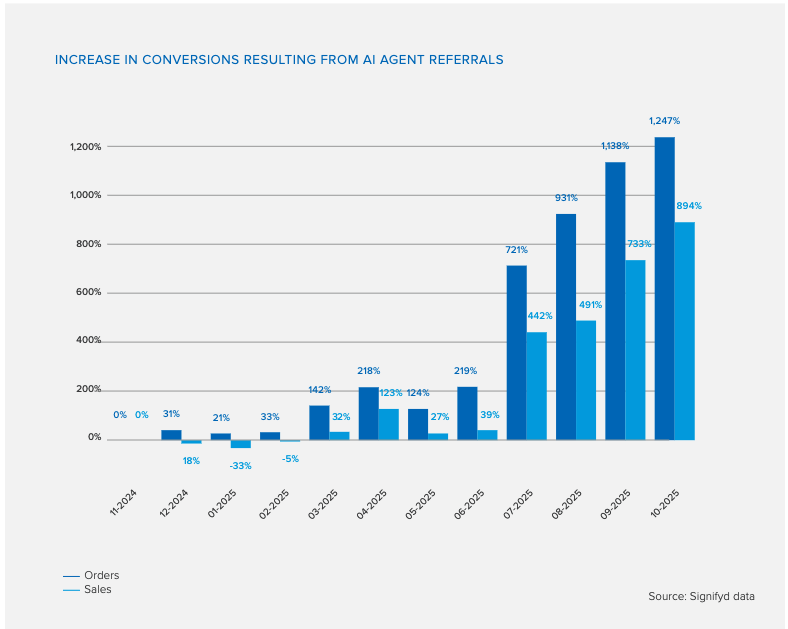
And while there has been a lot of talk, it’s been more than just talk. There’s substance: Signifyd’s Global State of Commerce 2026 report found that, in October 2025, orders from AI agent referrals in Signifyd’s Commerce Network were up 1,247% from a year earlier, while sales from those referrals climbed 894%.
That does not mean every shopper is about to hand purchasing decisions over to an AI agent overnight. But it does suggest agent-assisted shopping is advancing quickly enough that retailers should be positioning themselves for success sooner rather than later.
TL;DR
- Agentic commerce shifts more of the shopping journey into the hands of AI agents, which changes how retailers get discovered, how orders reach checkout and how fraud needs to be assessed.
- Some of the benefits for merchants include new paths to demand and getting in front of more decision-ready shoppers.
- Challenges for merchants include reduced visibility, new chargeback and impersonation risks and weakened intent signals.
- Retailers that want to compete in this environment should focus now on product data quality, checkout readiness, identity, fraud controls and post-purchase clarity.
What is agentic commerce?
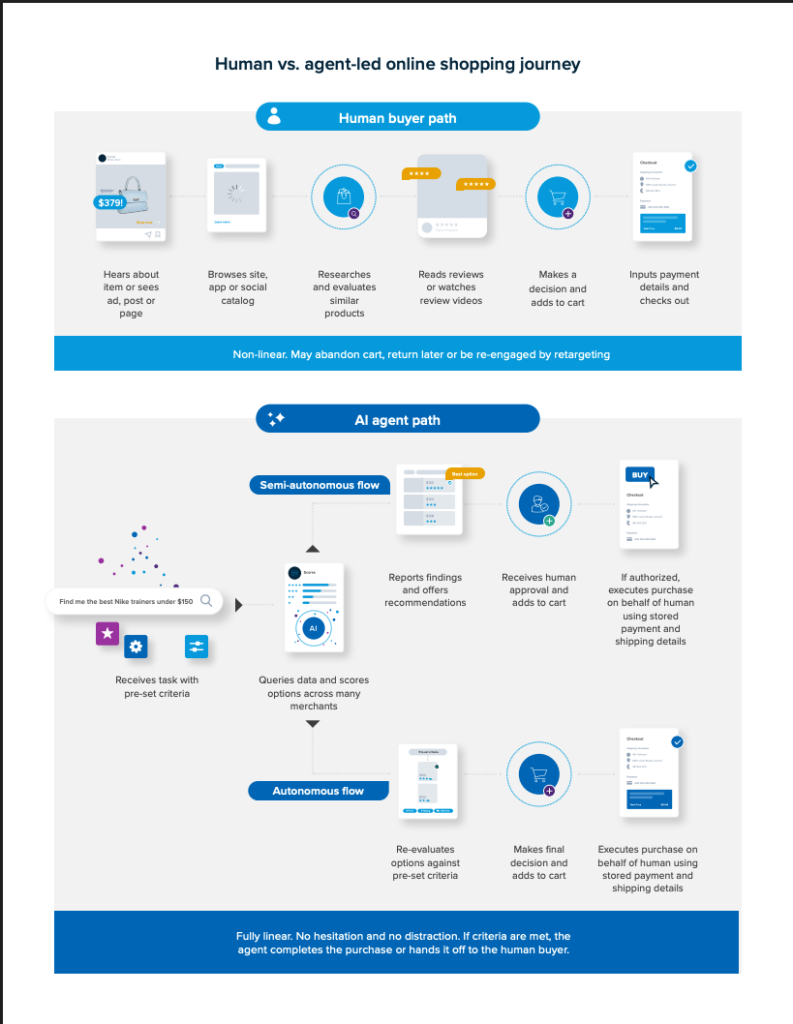
Agentic commerce is a form of shopping in which AI agents help browse, compare, select and sometimes buy products on a shopper’s behalf. Depending on the experience, the agent may research options across merchants, monitor price or inventory changes, build or update a cart and complete checkout once the shopper authorizes it.
With agentic commerce, the traditional customer journey is compressed or bypassed entirely, and control moves away from your browsing experience and into your data, policies and decisioning instead.
Human vs. agent-led online shopping journey
How does agentic commerce work?
In an agentic commerce flow, a shopper gives the agent a specific goal, like finding a floor-length wedding guest dress in their size for under $150, comparing two espresso machines with similar features, reordering the cat food they bought last month or watching a flight for a price drop.
The agent then uses available product and merchant information to evaluate choices, narrow the options, make recommendations and offer to take the next step. In some cases, that next step is sending the shopper to a retailer’s product page. In others, it may mean adding the item to a cart or completing the purchase, provided the shopper approves it and the platform supports that action.
Xavi Sheikrojan, Signifyd director, risk intelligence, digs into what the evolution of agentic commerce will mean for ecommerce fraud and risk professionals.
Benefits of agentic commerce for retailers
McKinsey & Company estimates that agentic AI agents will influence over $3 trillion in new global retail revenue by 2030. While that growth will not happen all at once, it does point to real upside for retailers. As agent-led shopping becomes more common, merchants could gain new ways to reach shoppers, shorten the path to purchase and drive more efficient repeat buying.
1. A new path to customer acquisition
Agentic commerce gives brands access to shoppers they might not have reached through traditional channels alone. It expands visibility, opens another source of demand and creates more opportunities to win consideration beyond branded search, paid media, social media and marketplace discovery.
2. More purchase-ready traffic
Shoppers who arrive through an agentic flow may come in with clearer intent and less need for early-stage comparison shopping. That can mean higher-quality traffic, less low-intent browsing and a shorter path to conversion.
3. Efficient reorders and repeat purchases
Repeat-purchase categories stand to benefit the most from agentic commerce. For merchants selling products shoppers replenish regularly, like pet food, vitamins, skincare or household essentials, that could translate into more repeat orders and steadier recurring revenue.
4. Better support for price-sensitive demand
Price-conscious shoppers often spend time waiting for the right deal, tracking multiple options or abandoning a purchase until the timing improves. Agentic commerce can help retailers capture more of that demand when their pricing, availability or promotions line up with what the shopper wants.
5. More value from operational strengths
Strong execution behind the scenes may matter more in an agentic shopping environment. Retailers with accurate inventory, competitive pricing, reliable fulfillment and clear policies could be better positioned to be surfaced in highly competitive categories like apparel and consumer electronics.
Challenges of agentic commerce for retailers
The opportunity in agentic commerce is real, but so are the tradeoffs.
“For retailers and for fraud teams as well, agentic commerce introduces a lot of fundamental shifts in risk, in visibility and in control.”
Xavi Sheikrojan, Signifyd director, risk intelligence
1. Lack of full visibility
Agentic commerce brings with it a lack of vision into where along the buying journey the key vulnerabilities arise. The introduction of third-party agentic bots potentially makes it harder to know if fraud is occurring at the agent stage or farther downstream on the merchant’s site. Not knowing where the specific vulnerability lies makes it difficult to assign responsibility and accountability.
2. Increased consumer confusion
Relying on an army of shopping agents could mean more chargebacks. For instance, a shopper might see a charge attributed to a purchase made via an AI agent. The statement could list the agent’s platform rather than the merchant involved. Or maybe the bot purchased from a merchant the consumer isn’t familiar with. That could lead to a dispute. Miscommunication could also complicate matters. What a consumer meant to ask a bot to shop for and what a bot actually determines a consumer wants could differ, leading to disappointment and chargebacks.
3. BTO or bot-takeover attacks
Think of BTO as account takeover on steroids. Seizing control of an agentic commerce bot could become the height of online fraud. Controlling the agent would allow fraudsters to race through the web making purchases in the victim’s name.
4. More social engineering and imitation schemes
Phishing and impersonation schemes could increase. Fraud rings might launch social engineering scams in which they send shoppers notices confirming agentic purchases they never made and suggesting they click on a link for more information. Once the consumer clicks, the fraudster makes off with valuable personally identifiable information and credentials.
5. Neutralizing site-level fraud protection
Depending on how and where a transaction actually takes place, bot purchases could circumvent a merchant’s extra site-level fraud controls. Maybe a merchant has created rules to weed out high value transactions or high-velocity activity. But if the purchase doesn’t make a traditional run through that site, those rules are meaningless for that particular purchase.
6. Higher return rates
If the agentic bot is providing product photos and descriptions or sizing guides or reviews, there is a chance some of that information could be inaccurate, depending on the original source. Erroneous information could lead to disappointment and a return and a refund request.
7. Need for new thinking
Fraud and risk professionals live in a world where bots are bad. Bots launch card-testing attacks.They enable mass purchases that fuel unauthorized reselling. Models are trained to deflect bot traffic. Old thinking runs the risk of turning good orders and revenue away — losing the immediate sale and perhaps future sales from that disappointed customer or well-trained bot.
8. Speed and scale in general
In fact, the enhanced automation that shopping agents provide means any scheme a fraudster or fraud ring can come up with can be executed with stunning speed and at breathtaking scale.
Which retail categories will feel the impact of agentic commerce first?
Grocery is a logical leader in agentic commerce
Consumers are understandably hesitant to blindly hand over their digital wallets to shopping bots. So, we’re likely a ways away from a mass movement to a world where AI agents — guided by prompts on selection, price, quantity and other guardrails — are automatically completing purchases.In laying out the need for building trust in the emerging agentic channel, Bain & Company produced a survey of U.S. consumers with ROI Rocket. They found that most consumers are familiar with AI, but that only 10% had ever used it to purchase a product.
Most of those, Bain wrote, relied on AI agents to buy groceries or household items. Makes sense, right? Groceries are generally low-risk, low-cost items. Many items on our grocery lists are weekly regulars — bread, eggs (OK, not everything is low cost), milk, toilet paper. Substitutions are usually tolerable — should a roma tomato show up instead of a vine-ripe, no problem.
Apparel shows promise in the AI agent era
Some apparel purchases seem primed for early agentic commerce activity. Certainly not the rare purchase of that perfect outfit for that special occasion, although that day is coming. But most wardrobes have a few go-to garments — polo shirts, socks, yoga pants, workout tops — some versions of which are purchased repeatedly, as needed.
Electronics are likely to cross the agentic chasm in classic fashion
The computer and electronics category sits in an intriguing spot at the dawn of the agentic commerce era. Many purchases involve high-value devices by consumers with fairly specific lists of features and specifications. Those contemplating a completely autonomous shopping journey might hesitate to turn so much over to a machine learning model. But many technology enthusiasts are early adopters and could be ready to go for it, even before the agentic commerce platforms are ready for them. Like so much about agentic commerce, we’ll have to see how adoption plays out in electronics.
The travel vertical will be another interesting study in agentic commerce
Travel, purchasing airline tickets for instance, is likely to follow a pattern similar to electronics. We’ll likely see frequent flyers and business travelers turning to AI agents early on and less-frequent, leisure travelers watching to see how things shake out.
Beauty and cosmetics, home goods, sporting goods and other ecommerce verticals will be mixed
Consumers shopping in other key retail categories — home goods, beauty and cosmetics, sporting goods and the like — will most likely adapt to agentic commerce on a highly individual level. The categories include products that consumers can be fairly particular about. Home goods are often big ticket items that will be around for a long time, for instance. Some sports equipment requires just the right fit or feel. But a regulation basketball is a regulation basketball. Beauty and cosmetic purchases literally affect the way the world sees us. The safe bet here is that agentic commerce will grow steadily in all categories — the question is how quickly.
How to prepare for agentic commerce
However fast consumers take to the new form of shopping and however long it takes for the necessary infrastructure to be in place to support full-on automated buying, retailers will be preparing for significant changes. Below are strategies brands can leverage to better position themselves in the agentic commerce era.
“The winners won’t necessarily be the ones with the best homepage; they’ll be the ones with the cleanest data, strongest identity verification and most reliable operational signals. ”
Xavi Sheikrojan, Signifyd director, risk intelligence
1. Improve visibility across the buying journey
Track what happens before, during and after checkout so your team can spot where risk enters the flow and which controls need to change.
2. Make product data easy for agents to understand
Keep pricing, sizing, materials, availability and shipping details consistent across your site, feeds and APIs to improve product matching and reduce avoidable returns.
3. Strengthen identity signals at checkout
Rely less on behavioral cues and put more weight on verified identity signals like email, phone, device consistency and account history.
4. Update checkout and payments to support trusted agents
Remove unnecessary friction and make sure your checkout, payments and order systems can handle shorter, agent-led purchase paths.
5. Build fraud controls for agent-driven behavior
Rework bot rules, velocity thresholds and risk logic so they can separate trusted agents from malicious automation.
6. Review declines before treating them as losses
Audit soft declines and outdated suppression rules to recover valid orders that agent-led flows may otherwise abandon.
7. Protect against agent abuse and impersonation
Monitor for unusual agent-linked activity, add stronger checks for high-risk actions and use real-time protection to catch abuse early.
8. Make purchases and communications easier to verify
Use clear confirmations, recognizable billing descriptors and simple order-verification paths to reduce shopper confusion and phishing risk.
9. Tighten the post-purchase experience
Provide clear order updates, return guidance and fast resolution to reduce disputes, preserve trust and limit chargebacks.
How Signifyd can help in an agentic commerce world
As AI plays a bigger and bigger role in consumers’ online shopping excursions, AI-driven commerce protection solutions become all the more important. Signifyd’s Commerce Protection Platform combines the scale of data and the sophistication of machine learning models necessary to prepare for the future of commerce. The technology is backed by fraud, risk, data and technology experts who can provide the kind of consultative guidance that every successful retailer will need as the world in which we all operate continues to evolve and innovate.
Understanding identity and intent
Signifyd’s Commerce Network protects merchants based on millions of daily transactions executed on many retail verticals around the world. Driven by AI, it establishes a baseline of behavior that is updated constantly by additional behavioral and transactional signals. To operate successfully in the agentic commerce era, you want visibility into a new baseline of bot behavior that doesn’t resemble human behavior, but doesn’t result in fraud either. That builds an understanding of the identity and intent behind automated purchases.
Consortium data for better insights
Signifyd provides insights into shopping agents’ meta data and it analyzes their AI-driven intent. This gives merchants important context behind a purchase by combining global pattern recognition with individual transaction insights. It analyzes whether a transaction is consistent with past behavior, preferences and authorization patterns or whether the transaction is out of the ordinary. Signifyd’s solutions also differentiate between human-approved automation and malicious bots, using techniques like AI fingerprinting and transaction metadata analysis. By leveraging real-time updates from a global merchant network, intent models continuously learn from new attack patterns and evolving buyer behaviors.
Intelligent returns protection and management
Signifyd can also protect against an increase in returns — whether abusive, fraudulent or excessive — stemming from bot behavior. Decision Center enables merchants to customize the response to return requests depending on the level of risk they entail. Similarly, Instant Refunds provides a way to calibrate the speed with which the refund is approved. A merchant can refund a loyal customer’s purchase immediately or delay a refund for a consumer with a checkered history until the returned product and its condition are verified.
Agentic fraud protection
Agentic fraud risk can move faster and look different from what retailers are used to seeing. Signifyd’s Guaranteed Fraud Protection uses real-time, AI-powered decisioning to evaluate orders and approve more legitimate transactions. If an approved order later turns into a fraudulent chargeback, Signifyd reimburses the merchant, including shipping and other fees.
Preparing for agentic commerce starts here
Agentic commerce may still be early, but retailers do not need to wait to prepare for it. As more of the buying journey moves through AI-driven intermediaries, the merchants in the best position will be the ones with stronger product data, clearer identity signals and fraud controls that can keep up with faster, less visible purchase paths.
Photo by Getty Images
Want a deeper look at what the agentic commerce shift could mean for fraud, trust and readiness? Read our white paper.
FAQs
What are the key characteristics of agentic commerce?
Agentic commerce is shopping that an AI agent carries out on a person’s behalf. A few key characteristics of agentic commerce include:
- It handles the research-side of online shopping. Agents gather and weigh information across products and brands — specs, reviews, pricing — to narrow down and provide the best options to the shopper.
- It can act, not just suggest. The agent can evaluate products and, in some cases, complete a purchase on its own if authorized to do so by the human shopper.
- It monitors on request. If instructed to do so, agents can track prices, availability and product details as they change and alert the shopper in real time.
- It shops around. A single agent can move across multiple retailers to compare options and find the best fit.
- It can create more personalized experiences. Over time, agents learn from past purchases and feedback to make better calls in the future when they surface new products to shoppers.
How are agentic commerce and traditional ecommerce different?
Traditional ecommerce and agentic commerce are different in a few key ways. In traditional ecommerce, humans browse, evaluate products and complete purchases themselves. In agentic commerce, AI-powered agents perform these tasks autonomously based on consumer-defined preferences and parameters. In order for merchants to be successful as agentic commerce becomes more popular, merchants need to optimize for both agent and human interactions.
What are some of the pros of agentic commerce for merchants?
Some of the pros of agentic commerce on the merchant-side include:
- New sales channel as consumers shift discovery and purchasing to AI assistants
- Reduced cart abandonment when agents complete checkout autonomously
- Lower customer service load for routine transactions and reorders
- Access to high-intent buyers (agents typically act on a clear purchase goal)
- Potential for automated, recurring/replenishment orders without manual prompting
- Richer demand signals if agents share structured purchase intent
What are some of the cons of agentic commerce for merchants?
As with anything, there are challenges merchants can face when it comes to agentic commerce, which can include:
- Loss of direct customer relationship and brand touchpoints (the agent becomes the intermediary)
- Reduced ability to upsell, cross-sell or influence with merchandising and user experience
- Margin pressure if agents commoditize products and optimize purely on price/specs
- Dependence on a few large AI platforms for surfacing
- Constant adaptation cost as agent selection criteria change
- Harder to capture first-party data and build loyalty
- Integration and infrastructure cost to support agent-readable catalogs and checkout